
Driven by R&D, we create
Unique products
R&D drives new products and services, or innovation within the existing offering, and the financial benefits that follow.
Funding & tax relief
R&D opens access to public-sector innovation grants and global funding, and to R&D tax relief.
Competitive advantage
New products and services create intellectual property and establish market leadership.
Collaboration
Working with enterprises and universities transfers skills and knowledge and gives access to facilities and expertise.
Brand & reputation
Partnerships with trusted scientific institutions strengthen the commercial success of resulting products.
Current and recent projects

Fed4Fire — Field Research on Precision Agriculture With LoRa (PAWL), 2nd phase
As an IoT solutions provider for precision agriculture supporting farmers and agronomists all over Greece, PANGAEA ran the PAWL experiment to compare the performance of LoRa (a low-power wide-area modulation technique) with existing ZigBee-based solutions in open-field applications.
Read more
PAWL used the existing NITOS/LoRa agricultural testbed, which offers autonomous IoT nodes in open fields, integrated with existing agricultural IoT nodes for a side-by-side comparison in a realistic environment.
PANGAEA also ran in-house lab experiments to measure the power consumption of LoRa and ZigBee modules in their various configuration modes.
The knowledge gained optimises the cost-effectiveness and reliability of our IoT solutions in coverage, throughput and energy efficiency, and confirmed the feasibility of LoRa in our precision-agriculture products.
FLEXPRESS – Materials as a Service
An innovative thermal expansion damping mechanism for fluids, from materials science to digital transformation.
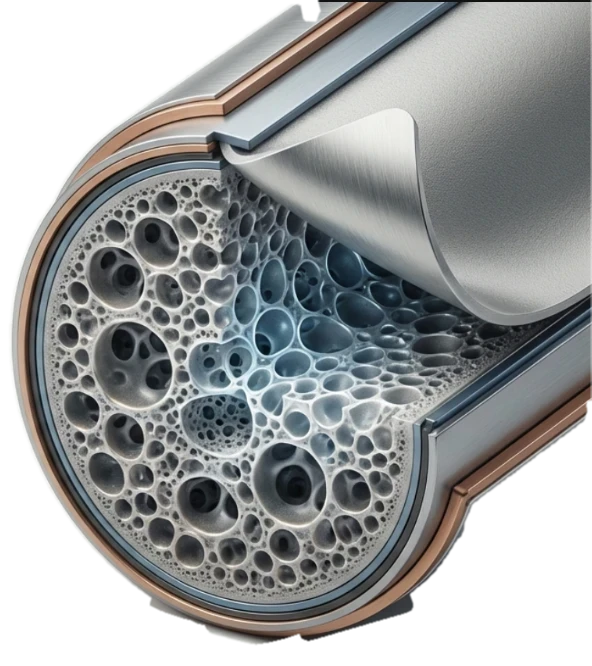
In closed thermohydraulic circuits, the thermal expansion of fluids causes pressure peaks, wear and loss of efficiency. FLEXPRESS develops and certifies the New Thermal Expansion Damping Mechanism (NTEDM / ΝΜΑΘΔ): a metamaterial with a vacuum micro-structure that uses the entropic elasticity of elastomers to absorb volume and pressure passively, going beyond conventional gas-compression expansion vessels.
Closed micro-cavities under vacuum sharply lower the material’s bulk modulus and thermal conductivity, giving large volumetric deformation and effective damping, with applications in heat pumps, data-centre cooling, energy, aerospace and medical technology.
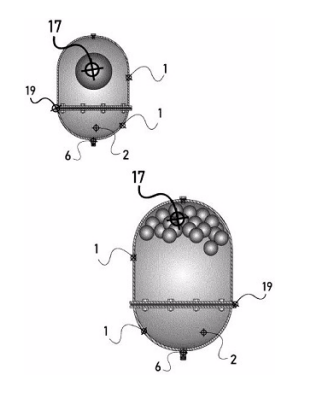
ΣΥΜΘΥΣ test rigA prototype closed-loop rig for material behaviour under variable thermohydraulic conditions: 5–300 °C, 1–16 bar, 3D deformation mapping, high-resolution DAQ and long fatigue cycles, to PED, LVD, EMC, EN 12828 and ASHRAE.
Digital Twin & AICFD/FEA models fused with test data and generative AI for inverse design of metamaterial micro-architectures (led by PANGAEA R&D®).
Material-as-a-ServiceGuaranteed performance with low upfront risk (CAPEX→OPEX), pilots in heat pumps, solar systems and data centres, plus IP/FTO and licensing.
Closed-loop research methodology
Experimental validation and computational modelling run in a continuous optimisation cycle. Data from the ΣΥΜΘΥΣ (BMVTHC – Behaviour of Materials under Variable Thermo-Hydraulic Conditions) platform, using water, glycol mixtures and dielectric fluids, continuously update Digital Twin models that combine CFD, FEA, physics-based constitutive models and thermo-hydraulic simulation. AI algorithms then learn the relationship between material architecture and performance and propose new designs.
- Material design
- Prototype manufacturing
- Experimental validation
- Digital Twin updating
- AI optimisation
- Material redesign ↺
Results & innovation
- A validated family of NTEDM metamaterials and a permanent experimental research infrastructure.
- Digital Twin libraries, AI optimisation algorithms and engineering databases for future industrial applications.
- AI-enabled Material-as-a-Service: instead of selling a passive component, advanced materials become continuously monitored engineering services, with predictive maintenance and lifecycle optimisation.
Application sectors
- Heat pumps
- District heating & cooling
- HVAC
- Renewable energy
- Industrial thermal processes
- Aerospace
- Medical devices
- Data-centre cooling
Improved pressure stability, lower maintenance and higher energy efficiency.
Presented at SUSTENG 2026
“FLEXPRESS® Material-as-a-Service: An Innovative Fluid Thermal Expansion Damping Mechanism – From Materials Science to Digital Transformation.”
T. Theodosiadis-Thomaidis, G. Panagopoulou, A. Aivazoglou (PANGAEA R&D® PC) and T. Matikas (MSS-NDE Lab, Department of Materials Science and Engineering, University of Ioannina) · 5th International Conference on Sustainable Chemical and Environmental Engineering, 2–5 September 2026, Rethymno, Greece
Conference abstract (PDF, 0.6 MB)30-month programme maturing the technology from TRL 4–6 (lab prototype) to TRL 7–8 (pre-industrial pilots with compliance). Smart-specialisation priority EL54_01.09.06: composite and nanocomposite materials with enhanced properties.
Patents
FLEXPRESS builds on existing patented materials technology, which documents the novelty and inventive step of the mechanism:
- GR patent application ΟΒΙ 20230100792 (filed 02/10/2023) · IPC F24D 3/10, F24H 1/18
- Greek patent ΔΕ 1010926: “New thermal expansion damping mechanism” (granted 07/04/2025)
- International PCT application PCT/GR2024/050003
FRAMS
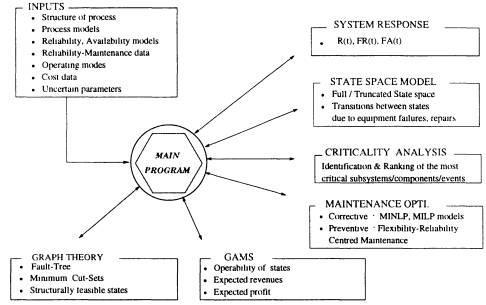
A software prototype for incorporating Flexibility, Reliability, Availability, Maintenance and Safety in complex systems design and operations.

- Based on stochastic modelling of continuous and discrete-state uncertainty, with analytical tools for quantifying operability and for identifying and ranking critical equipment and critical events.
- Supported by a software package for the design and operability optimisation of process systems.
- Incorporating operability measures at the early design stage brings economic benefits and inherently more flexible, reliable and safe designs.
Integrating operability objectives (flexibility, controllability, reliability, maintainability, safety) into design requires a common mathematical framework of:
Continuous uncertainty
Internal or external uncertain parameters, described by continuous probability distributions.
Discrete uncertainty
Equipment availability, unexpected events and faults, using reliability models and discrete probabilities.
System model
Equality and inequality constraints, physical and design equations and product specifications, typically a differential-algebraic model.
Design for Reliability
“Optimal design of flexible & reliable process systems: Design for reliability.”

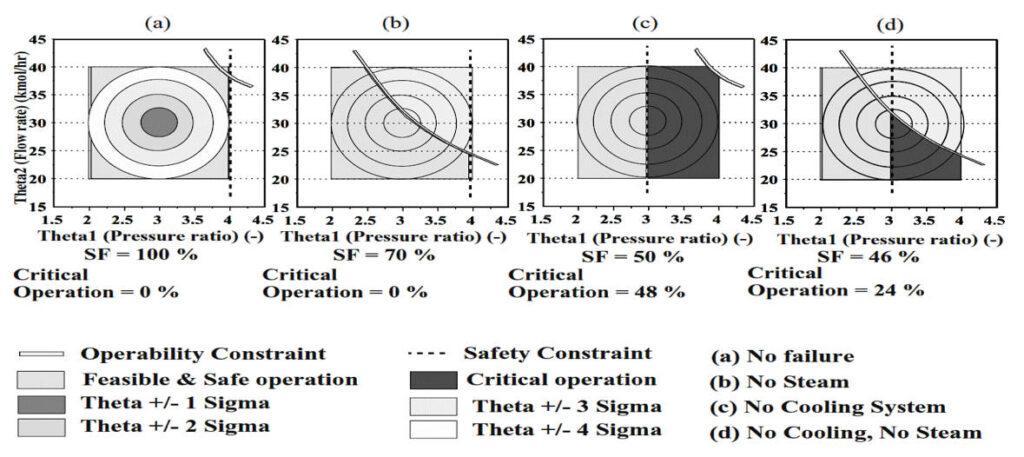
Two categories of uncertainty matter in the design and operation of chemical process systems: continuous process parameters (product demands, feedstock qualities, reaction kinetics) and discrete states, typically equipment availability. The paper presents a general framework for both and introduces a combined flexibility-reliability index (FRI) that measures a system's ability to cope with stochastic parameter variations and equipment failures, explicitly accounting for operational interactions and constraints. A design optimisation procedure then yields flexible, reliable systems at minimum investment cost and maximum average profit.
Criticality analysis of complex systems
Development of computational tools for criticality analysis of process systems, utilising Industrial IoTs.

Fault-tree analysis and FMEA are well-established methods for identifying critical equipment and events, but they do not explicitly account for process models and interactions, which can overestimate system efficiency and mis-rank critical components. PANGAEA R&D® presents a uniform framework, computational tools and algorithms for criticality analysis that combine:
- system logic via Directed Functional Logic Digraphs (DFLD) and the Fault-Tree Diagnosis System (FTDS);
- explicit process and safety models, equipment reliability data and probabilities of external events, using data collected via Industrial IoTs.
The criticality analysis module
Identifies the relative importance of equipment (un)availability and other external events over a time horizon, taking into account process interactions, reliability models, parameter variations and operating characteristics. It comprises:
- Size reduction of the system state space
- Translation of the process flowsheet into a DFLD (automatic generation of fault trees and n-order cut sets)
- State probabilities and a system criticality index as functions of time
- A combined flexibility-reliability-criticality index for each piece of equipment or event
- Criticality-based and condition-based maintenance scenarios
- Effective risk assessment
- Fault trees
- FMEA
- NASA FTDS
- Predictive maintenance
- Industrial IoT
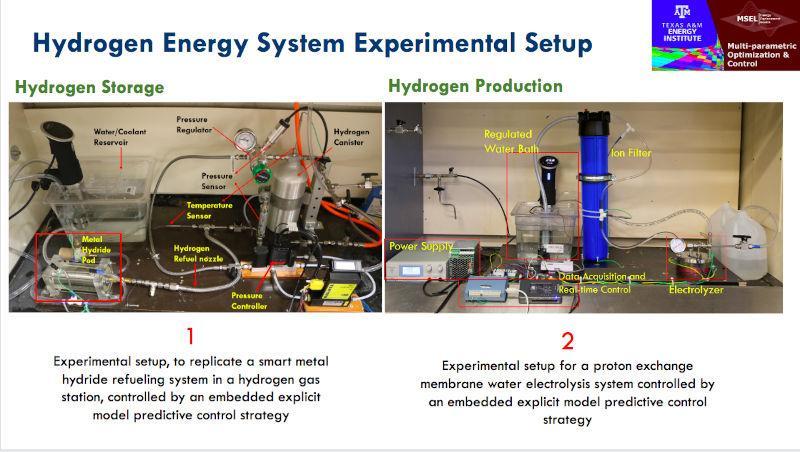
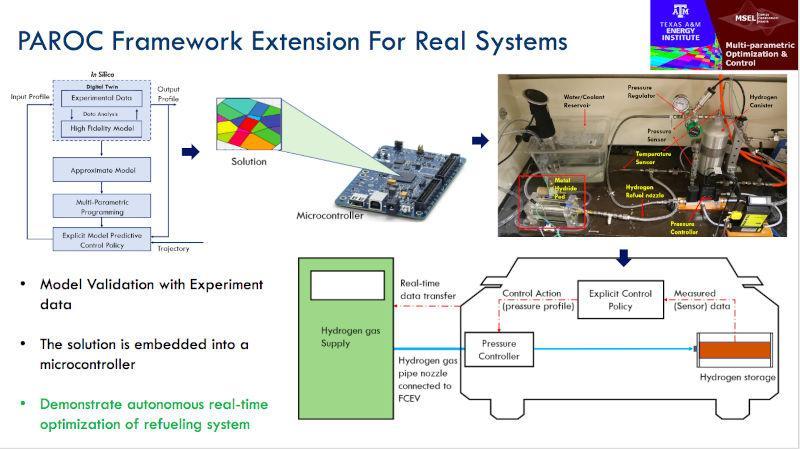
PAROC — Parametric Optimization & Control
An integrated framework and software platform for the optimisation and advanced model-based control of process systems.

PAROC enables model-based tools for design, operational optimisation and advanced control through a step-wise procedure:
Development, validation and analysis of a high-fidelity dynamic model.
Model approximation: system identification, model reduction and global sensitivity analysis.
Receding-horizon modelling for model-predictive control (MPC) and reactive scheduling.
Multi-parametric programming for optimisation under uncertainty, explicit MPC and state estimation.
“In-silico” validation of the derived strategies against the original high-fidelity model.
Demonstrated on a combined heat and power system, a distillation column and a periodic purification process for biopharmaceuticals.
Patents employed in the PAROC control technology
| Patent | Title | Year |
|---|---|---|
| EP1399784 | Improved Process Control | 2004 |
| US7433743 | Process Control Using Co-ordinate Space | 2008 |
| WO2020227550-A1 | Refueling Metal Hydride Storage System | 2020 |
Patented materials technology in the portfolio
The portfolio also includes existing patented materials technology, protected in Greece and internationally:
| Filing / Patent | Office | Date | IPC |
|---|---|---|---|
| Application 20230100792 | OBI — Hellenic Industrial Property Organisation | 02/10/2023 | F24D 3/10, F24H 1/18 |
| Patent ΔΕ 1010926 | OBI — Hellenic Industrial Property Organisation | 07/04/2025 (grant) | F24D 3/10, F24H 1/18 |
| PCT/GR2024/050003 | WIPO — international (PCT) application | 2024 | F24D 3/10, F24H 1/18 |
This technology is the basis of the FLEXPRESS project.
Publications & conferences
We participate in the SUSTENG International Conferences (2022, 2023, 2024, 2025, 2026) and publish in journals such as Chemical Engineering Science, Computers & Chemical Engineering and IEEE Transactions on Reliability.
| Year | Publication | Venue |
|---|---|---|
| 2026 | FLEXPRESS® Material-as-a-Service: An innovative fluid thermal expansion damping mechanism – from materials science to digital transformation | 5th SUSTENG 2026, Rethymno |
| 2022 | Development of computational tools for criticality analysis of process systems, utilizing Industrial IoTs | SUSTENG 2022, Rethymno |
| 2015 | PAROC — An integrated framework and software platform for the optimisation and advanced model-based control of process systems | Chemical Engineering Science 136 |
| 2004 | Criticality analysis of process systems (T. V. Thomaidis, E. N. Pistikopoulos) | AR&MS 2004, paper 2004RM-127 |
| 1995 | Optimal design of flexible and reliable process systems (T. V. Thomaidis, E. N. Pistikopoulos) | IEEE Transactions on Reliability 44(2), 243–250 |
| 1994 | Integration of flexibility, reliability and maintenance in process synthesis and design | Computers & Chemical Engineering 18, S259–S263 |
Abstract — Integration of flexibility, reliability and maintenance in process synthesis and design (1994)
The paper addresses simultaneously accounting for continuous uncertainty, equipment failures and maintenance policies during the design of processing systems. Based on analytical tools for quantifying flexibility, reliability and maintenance, a mixed-integer nonlinear programming model is proposed for the overall operability optimisation of a process system at minimum cost. Through the design of a gas transmission network, it shows that integrating these stochastic operability measures at the early synthesis level results in inherently flexible and reliable designs.
ScienceDirect ↗